The reading fluency assessment platform that brought objective evaluation to state public schools

The Government of Paraná manages education for hundreds of state public schools serving millions of K–12 students. It faces the ongoing challenge of ensuring quality learning at scale across municipalities and regions with different infrastructure and capabilities. State public education involves the operational complexity of multiple locations, each with its own dynamics, where curriculum and teaching intervention decisions must rely on trustworthy learning data. Public education innovation requires more than technology: it must connect with classroom realities and teachers' needs.
The Challenge
Assessing reading fluency at scale across state public schools is complex. Teachers work daily with students at different reading levels, and education leaders must allocate resources and plan learning recovery without objective proficiency data. Assessing every child individually takes time, expertise and a consistent methodology, making it difficult to scale across hundreds of schools and tens of thousands of students simultaneously.
Paraná needed structured, reliable assessments without relying on manual teacher evaluation. The more precise and individualized a fluency assessment is, the more teacher time it requires. As scale grows, less time is available unless technology takes on the assessment while teachers focus on instruction.
The Solution
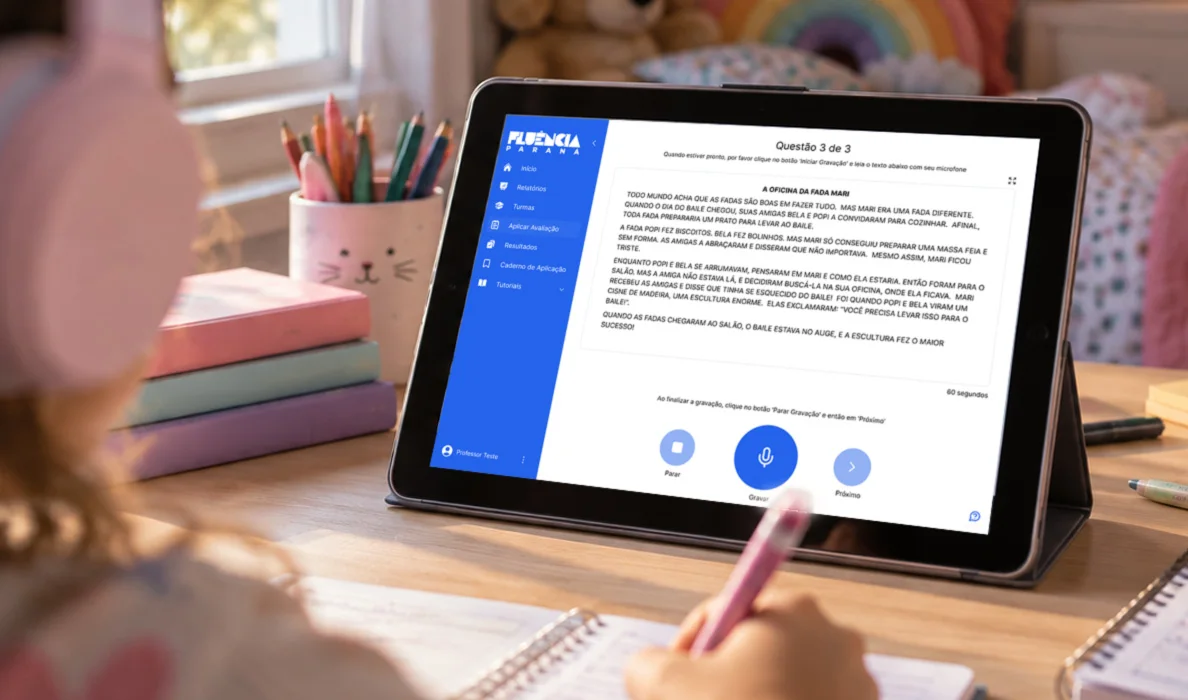
The Government of Paraná retained authority over the platform's educational design, defining fluency criteria, proficiency levels, assessment protocols and learning recovery guides aligned with state literacy policy. Radhark took end-to-end technical responsibility, from capturing reading audio to generating reports and dashboards for teachers and administrators.
The solution fully automated fluency assessment using generative AI. Students complete timed readings at different difficulty levels with audio recording. The AI model analyzes recordings and calculates accuracy, speed and comprehension metrics, producing an automated, individualized assessment of each child's proficiency. Reports are organized by student, class, school and state network, with specific educational recommendations for intervention and learning recovery.
The Result
Paraná transformed reading fluency assessment from an isolated performance measure into a continuous cycle of assessment, intervention, monitoring and learning recovery. Teachers and administrators gained objective data to identify gaps, track each student's progress and guide more precise interventions statewide. Reports help teachers organize strategies, activities and groupings suited to students' actual needs, supporting more personalized instruction.
For state education policy, the impact was twofold: it enabled a management tool based on objective data and strengthened continuous assessment across the state network, turning assessment into a tool for educational inclusion.
Related projects
The continuing education platform that changed how personalized learning is delivered
The way professionals learn throughout their careers is changing. Undergraduate, graduate, master's and doctoral programs remain relevant, but they no longer account for all demand for professional development. People increasingly seek shorter, practical continuing education experiences connected to their day-to-day work.
The reading fluency assessment platform that turned evaluation into teaching action
Assessing one child's reading requires close attention. Doing so for thousands in a timely way changes the problem entirely. We created a solution that turns voice into learning data, automating part of the assessment to increase scale while retaining an educational view of each student.
The reading fluency assessment that brought evidence of learning to public school systems nationwide
Saber Educação is the K–12 education division of Grupo Cogna Educação, a publicly traded company on Brazil's B3 exchange (ticker COGN3). It has served the Brazilian education market for decades as a leading provider of educational content and teaching systems.
The cloud infrastructure that connected innovation to legacy systems without disrupting operations
Grupo Marista is a large independent education network with 96 locations across 21 Brazilian states and the Federal District. It operates private and social schools that serve thousands of students free of charge.